

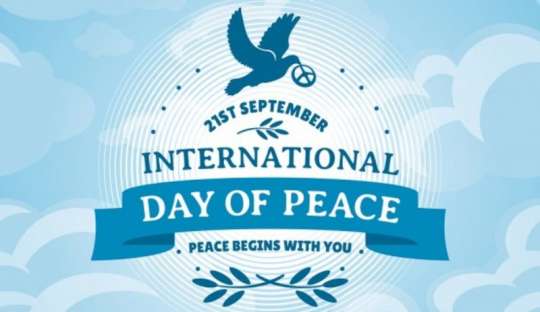
As the world marks International Day of Peace on Friday, September, 21, Ghana has moved up six points to rank 41st on this year’s Global Peace Index (GPI), while it occupies the fifth position in Sub-Saharan Africa.
Mauritius, Botswana, Sierra Leone and Madagascar are the front runners of Ghana on the 2018 GPI, released annually by the Institute for Economics & Peace (IEP), an independent, non-partisan, non-profit think tank, based in Sydney.
The National Peace Council, in a statement issued to the Ghana News Agency, to mark the Day, commended Ghana for improving its record, noting that the country had generally been faring well in the arena of peace.
More Read

The Statement, signed by the Chairman of the Council, the Most Reverend Professor Emmanuel Asante, however, cautioned against complacency on the part of the security agencies, the citizenry and the Government.
It, therefore, urged the Government to commit financial and technical resources to speedily deal with threats related to land and chieftaincy disputes, political vigilante groups, electoral violence and issues arising from the proposed referenda on the creation of six regions.
It mentioned the conflicts at Bimbilla and Dagbon in the Northern Region, Alavanyo and Nkonya in the Volta Region, as well as the post electoral feud at Sankore in the Brong Ahafo Region, as needing critical attention from all key stakeholders to engender lasting peace.
The National Peace Council stated: “It is important to draw attention to the fact that extremist religious and political tendencies are increasing in the sub Saharan region. We therefore, encourage and urge government to increase its efforts in making the country more inclusive and participatory in decisions that affect the people.
“We call on the security agencies, especially the Ghana Police Service, to deal decisively, with those who flout the law and are involved in activities that have the potential to derail the peace of the country without fear or favour”.
The Government, the Peace Council said, must also continue to work with all relevant stakeholders to implement policies and programmes that engender economic growth and equity to reduce structural violence caused by unemployment, poverty, exclusion among others.
Efforts to promote industrialisation must be intensified to provide jobs for the teeming youth and create the enabling business environment to empower budding entrepreneurs, especially, in agriculture and manufacturing.
“The Right to Peace – The Universal Declaration of Human Rights at 70”, is the theme the United Nations has assigned for this year’s International Day of Peace.
According to the GPI, which assessed 163 independent states and territories, the average level of global peacefulness has declined for the fourth consecutive year, falling by 0.27 per cent in 2017.
“Ninety-two countries deteriorated, while only 71 improved in peacefulness. The Middle East and North Africa (MENA region) remained the world’s least peaceful region, with four of the 10 least peaceful countries in the world being located in that part area,” the statement said.
South Sudan, Somalia and Central African Republic are among the five least peaceful countries in the world.
On the positive side, Iceland, Norway and Denmark are most peace countries.
The global economic impact of violence was $14.76 trillion in 2017, equivalent to 12.4 per cent of global Gross Domestic Product.
The Institute for Economics & Peace (IEP), which has been releasing the GPI, for the past 12 years, uses 23 key qualitative and quantitative indicators, from highly respected sources, that measure the state of peace, using three thematic domains, for the ranking.
These are the level of Societal Safety and Security; the extent of Ongoing Domestic and International Conflict; and the degree of Militarisation of countries.
Source: GNA