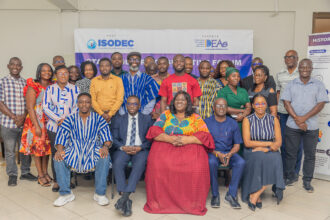


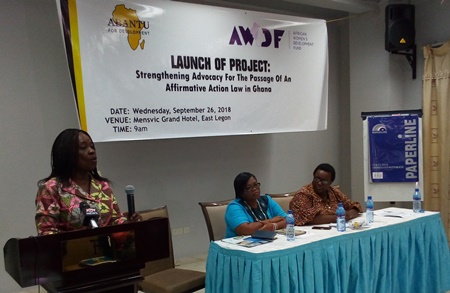
Abantu for Development, a women’s right advocacy group has launched a project meant to strengthen advocacy on national commitments towards the passage of an affirmative Action law in Ghana.
Launched on the theme ’Strengthening Advocacy for the Passage of an Affirmative Action Law in Ghana, ’the project’s ultimate goal is to secure the best gender equality outcomes for all citizens in public life.
The project also seeks to develop and implement a nationwide affirmative action campaign strategy in order to strengthen advocacy initiatives for the passage into law of the Affirmative Action Bill.
More Read

Project is being implemented by Abantu for development with support from the African Women’s Development Fund {AWDF}.
Ghana was the first African country after independence to institute a legislated Affirmative Action Act passed in June 1960 which allowed 10 women members unopposed to represent the regions of the country in the then legislature.
The law acceded to the fact that women’s political participation is a critical component of democratic dialogue and social cohesion. However, the law was lost under the weight of the political upheavals that occurred in the intervening years in the country according to Abantu’s report.
Since then, the nation has made various commitments by signing to global declarations and protocols that call for increased women’s participation and representation in public life.
Through these instruments, Ghana has been mandated to institute measures, specially affirmative action mechanism as one of the means of addressing the problem of exclusion of the marginalized, especially women, the failure of which will make Ghana unable to attain parity until beyond 2050s. Yet, 48 years on, in Ghana’s 275-member Parliament, women’s representation is thirty seven{37}, representing 13 per cent falling short of the minimum UN recommended threshold of 30 per cent. Local government’s elections of 2015, produced three {3} per cent women representation, far below previous years, making gender-based exclusion in these structures a major fault-line in equality in participation.
Inclusive political participation as an approach has become central to development initiatives and are at the heart of the global frameworks for development including the Sustainable Development Goals {SDGs}.
It is expected to result in the inclusion in power-sharing and control of resources to the marginalized, especially women. That women’s increased entitlement to participate in formal representative politics, contribute their perspective in public discourse is vital to democratic governance, reducing poverty, hunger, violence, bring greater equality, peace and security.
Rwanda, Uganda, Gambia, Liberia, Kenya, South Africa and Senegal, for example, have passed Affirmative Action Laws resulting in marked improvement in women’s participation and a corresponding positive impact in national development.
In recent historical development, Ghana has made attempts since 1998 starting with the Affirmative Action Policy Guidelines to promulgate an Affirmative Action Law without concrete results. Civil society organizations, like Abantu, have worked over the years to advocate for measures, policies and mechanisms like Affirmative Action that will address the invisibility of women in key positions in all national sectors for socio-economic development and sustainable progress.
Currently, Ghana has drafted an Affirmative Action Bill in response to its mandate to promulgate an Affirmative Action Law {AAL}as called in Article 4 and 7 of the Convention on the Elimination of all Forms of Discrimination against Women{CEDAW-1981}which Ghana ratified in 1986. This development was also influenced by intense advocacy by women’s groups.
‘’We see the movement to social equality for women has been restrained and the national urgency needed to direct the process to see this Draft Bill passed into law is agonizingly slow.’ Abantu stated in a concept note ’
It added, “That is why it is critically important to up-scale and implement effective strategies to secure the passage of the Bill into Law in order to enhance the principles of political pluralism, democracy and good governance the report indicated.
“Gender equality and social inclusion objectives will only be met if there is commitment, sufficient urgency and political will.”
By: Latifa Carlos