

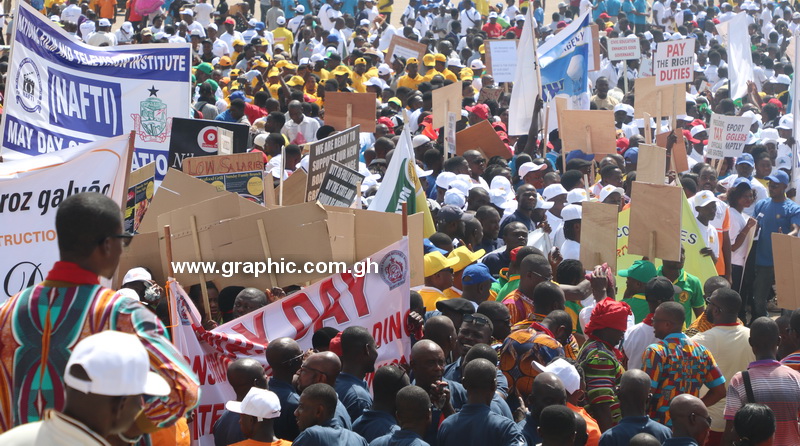
The Trades Union Congress (TUC) has described the frequent redundancy at workplaces as a worrying development in many working environments in the country.
It has therefore called on the government to amend the country’s Labour Act, Act 651 to help protect Ghanaian workers from exploitation, mainly by foreign-owned firms.
Speaking at the May Day celebration in Accra on behalf of the Secretary-General of the TUC, the Greater Accra Regional Secretary of the association, Madam Freda Stephanie Frimpong, said in spite of the fact that only a few Ghanaians have decent employment, they are continually threatened with redundancy by their employers.
More Read

“It is indeed very disheartening to note that even the few Ghanaians who have some form of decent employment are constantly being threatened with redundancy,” she said.
This year’s May Day celebration was held on the theme: “Sustainable development goals and decent work: the role of social partners”.
She said “the lack of decent employment is the greatest challenge facing Ghana today”, explaining that out of nearly 13 million Ghanaians who are eligible to work, just about two-million have jobs that can be described as decent, in relative terms.
Madam Frimpong said about 11 million Ghanaians, representing 85 per cent of the country’s working class are working in very precarious conditions with no hope for the future.
She said in 2015, for instance, over 5000 workers of the AngloGold Ashanti Obuasi Mines were laid off.
She said similar incidents happened at the Goldfields Ghana Limited Tarkwa Mine early this year with over 2000 workers losing their job.
She said it was unacceptable to create an atmosphere in the country where workers cannot protest against decisions against them by their management, noting that some workers who protested against their redundancy at the Goldfields Ghana Limited Tarkwa Mines were left in the hands of armed police and military officers by their organisations.
“What is democracy if workers cannot protest against a mass redundancy exercise that only aims at profiting foreign shareholders and a few privileged Ghanaians,” Madam Frimpong said.
She added “almost all the newly-registered stevedore and shore-handling companies in our maritime industry are using contract and/or casual workers while the existing companies have either laid-off workers or are in the process of turning permanent employees into causal workers for no apparent reason other than profiteering.”
She therefore appealed to the president to “stop these unwarranted changes in modes of operation that are designed only to make supernormal profits in favour of foreign shareholders at the expense of Ghanaian workers.”
“We call on government to ratify International Labour Organisation (ILO) Convention 158 concerning termination of employment and to review the Labour Act, 2003 (Act 651) to make it an effective instrument for protecting Ghanaian workers from employers who want to take advantage of the lapses in our labour law,” she said.
The Greater Accra Regional Minister, Mr Ishmael Ashitey, said the government subscribes to the global agenda with particular emphasis on economic growth and employment.
“We believe that placing job creation at the heart of economic policy-making and development plans, will not only generate decent work opportunities but also promote inclusive and poverty-reducing growth,” he said.
He, however, said workers, employers and government as social partners all have a crucial role to play in achieving the SDGS 8.
“Creating more jobs and achieving the SDGs is thus critical for us as a country and a lot will depend on you as workers and your continuous support and commitment to work is more critical,” Mr Ashitey said.
He said poverty reduction being goal number one of the SDGs can be achieved through different factors such as employment creation, social dialogue, development of social protection policies and the fight against corruption.
Source:Graphic.com.gh