
Public Agenda NewsPaperPublic Agenda NewsPaper
  • General News
  • Politics
  • Business
  • Health
  • Development Agenda
  • World News
  • Features & Opinions
  • Election watch
  • Editorial
Font ResizerAa
Public Agenda NewsPaperPublic Agenda NewsPaper
Font ResizerAa
  • General News
  • Politics
  • Business
  • Health
  • Development Agenda
  • World News
  • Features & Opinions
  • Election watch
  • Editorial
Search
  • General News
  • Politics
  • Business
  • Health
  • Development Agenda
  • World News
  • Features & Opinions
  • Election watch
  • Editorial
Follow US
Breaking NewsBusinesstop stories

E-Levy: 8 out of 10 Ghanaians have changed MoMo transaction behavior – Study

Suleman
Last updated: June 24, 2022 10:23 am
Suleman
Share
2 Min Read
SHARE

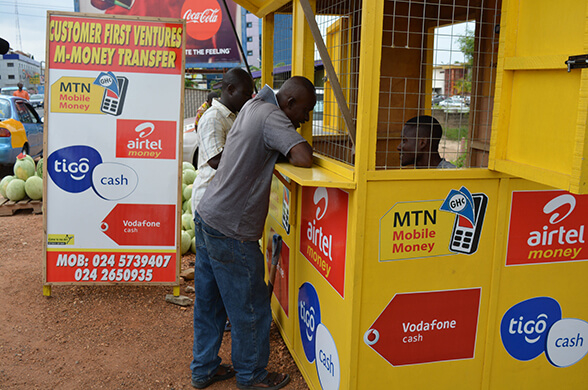
Majority of Ghanaians are said to have changed their behavior towards the electronic transfer of funds since the E-Levy kicked in back in May this year.

According to a study, 83% of the populace felt compelled to do so in order to adjust to the limits introduced by the said levy as far as their livelihoods are concerned.

These were part of research findings on the effect of the new tax slapped on citizens geared towards shoring up revenue for the government.

More Read

Ghana walks away from US health agreement over sensitive data concerns
Mali at risk of splintering after jihadi and separatist attacks
Create ‘water markets’ to fix Ghana’s supply challenges — Former GWL MD
National Water Justice Campaign Launched to Tackle Inequality in Access
ISODEC Urges Collective Action to Secure Safe Water for All Ghanaians

The IMANI Digital Financial Services Research Project looked into the impact of the 1.5% tax on the coping mechanisms thereof.

“To assess the impact of the e-levy on the use of digital financial services, we first assessed how often people use digital financial services accounts (such as mobile money) in a typical week and then asked further questions on how it has affected the volume of mobile money transactions they make.”

Highlights of the report revealed that out of the 83% who reassessed their electronic financial dealings nearly half of them reduced the rate at which they engaged in MoMo transactions.

“Of this number, about 47% indicated that they had reduced the number of mobile money transactions by about 51% to 100%,”

“Another 25% indicated that they had reduced their transactions by about 10% to 50%. Only about 1.6% of respondents indicated that their transaction volumes have stayed or increased their volume.”

Meanwhile, in terms of the regularity of transfers, the results were even.

The June 22 report also found that “about 31% of respondents indicated that they make between 1-2, 3-5 or more than five transfers per week.”

The study conducted by IMANI Centre for Policy and Education in collaboration with Deutsche Gesellschaft für Internationale Zusammenarbeit (GIZ).

Source:myjoyonline.com

Share This Article
Facebook Whatsapp Whatsapp Email Copy Link Print

Latest News

Man kills seven of his children, and an eighth child, in Louisiana mass shooting
April 20, 2026
A decade of African politics: democratic gains and new pressures
April 20, 2026
Minister Faults Nana Akufo-Addo Government’s Decentralisation Record
April 20, 2026
Bawumia engages Ken Agyapong ahead of 2028 polls
April 20, 2026
Over 100 communities in Volta Region at risk from tidal waves — Anlo MP
April 20, 2026
Underperforming ECG districts risk major shake-up — Jinapor
April 15, 2026
GIS to crack down on street begging, unregistered migrants in Accra
April 15, 2026

You Might Also Like

Breaking NewsDevelopment AgendaGeneral Newstop stories

Government engages sachet water producers today as price hike suspended

April 8, 2026
Breaking NewsGeneral Newstop stories

Healthy, thriving Africa key to global progress

April 8, 2026
Breaking NewsBusinesstop stories

Ghana’s inflation drops to 3.2% in March 2026

April 1, 2026
Breaking NewsPan Africa Politicstop stories

ISODEC Urges Action after Landmark UN Reparative Justice Resolution

March 31, 2026

About Us

Public Agenda is fou­nded and owned by Pu­blic Agenda Communic­ations.

Public Agenda was founded as a public interest Me­dia entity. Its Visi­on is to contribute to building a well-i­nformed society where accurate informati­on dissemination is the cornerstone of a democratic, just and equitable society.

Its mission is to inform, guide and bui­ld responsible citiz­enship and accountab­le decision making and strive for excell­ence in the media in­dustry. Public Agenda Communications is managed by a Board of Directors.

Welcome Back!

Sign in to your account

Username or Email Address
Password

Lost your password?