


The inability of parents and guardians to buy sanitary pads and properly feed young girls have been identified as key factors pushing young girls to engage in unprotected sex in the Ajumako-Enyan-Essiam District of the Central Region.
Some parents have neglected their core responsibility of caring for their children’s basic needs like food, medical care, shelter, clothing, love, attention, understanding, acceptance, quality time, and support.
Therefore, such space had been occupied by some unscrupulous men who use girls as sexual objects under the guise of buying them pads and providing money for food and other personal belongings as their parents looked on helplessly.
More Read

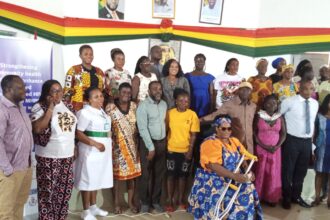
These came to light at a sensitisation programme for some selected adolescent girls, boys and parents on the implications of unprotected sex, sexual and gender based violence, domestic violence and reproductive health issues at Ajumako-Bisease on Tuesday.
It was put together by the Central Regional Department of Gender in collaboration with the Regional Coordinating Council and supported by the United Nations Population Fund (UNFPA).
According to the girls, high rate of unemployment among their parents had resulted in abject poverty, forcing their parents to shirk their obligations, leaving them at the sexual pleasures of unscrupulous men who lured them into unprotected sex leading to teenage pregnancies.
They explained that the situation had created a vicious cycle where young poor semi-educated girls have become premature poor mothers at the expense of their education and development.
“I have a friend whose parents have almost given her in marriage to a taxi driver who takes care of her. Others engage in disguised prostitution as income generating ventures to feed their families,” says Lydia Ankrah, a-15-year-old girl.
She added that many girls face considerable pressure to marry early in their communities to prove their fertility and also to ease the responsibility of their parents in their upkeep.
Ernestina Aidoo, a-14-year old girl said her 52 year old poor single mother could not afford to buy sanitary pad for her, so she had to used strips of cloth instead, anytime she was menstruating, a situation she said was sometimes unhygienic.
“I can’t blame my mother for giving me strips of cloth as pad because that is the best she can afford. Eventually, when the situation become unbearable, my mother forced me into unprotected sex with a-32-year old famer who occasionally gives me between 5 and 10 cedis.”
Florence Mensah, a-16-year-old, giving account of her personal experiences said her parents’ inability to care for her forced her to bow to incessant pressure from one of her school mates who later broke her virginity.
“I know friends who are in relationship with men as old as their father,” she added.
Generally, the young girls stressed the need for them to be empowered for them to be assertive and take bold decisions about their bodies, future and have access to appropriate healthcare services.
They urged parents and guardians to find some work doing to enable them invest in the education of their children and to train them well to help check delinquency and bad adolescents behavior.
According to the young girls, efforts to curb teenage pregnancies and end child marriages will help in retention of girls in school, adding that the authorities should also focus on empowering girls who cannot continue schooling economically, to learn trades of their choice.
They should also enforce laws on child marriage and effectively design tailored advocacy programs to educate key stakeholders and adolescent girls on the consequences of teenage pregnancy.
Additionally, there was the need to address socio-cultural norms, practices to help end child marriage.
Ms. Esther Amankwa, acting District Director of Health for Ajumako who corroborated the stories of the girls, decried the worrying trend of teen pregnancies in the District.
She mentioned other factors to include parental irresponsibility, poverty, unemployment, lack of understanding of adolescent reproductive health issues and assertiveness, illiteracy and low self-esteem among adolescent young girls.
Others are decreasing age of puberty, early age of sexual debut, early marriage, low use of contraceptives and lack of knowledge about sex and family planning.
To reverse the trend, she called for a collective efforts to preventing adolescent pregnancy, intensified sex education and strongly encourage abstinence or contraceptive use.
Terrified by the experiences of the young girls, Mrs Thywill Eyra Kpe, Central Regional Director of the Department of Gender with support from UNFPA, distributed quantities of sanitary pads to girls as a temporarily remedy to the situation.
She encouraged the youth to be determined to succeed in life and avoid all tendencies that derailed them.
Alan Paintsil, a Director at the Central Regional Coordinating Council, urged the participants to avoid bad friends who will lead them astray and take their lessons seriously.
Source: GNA